
News & Knowledge / Facts
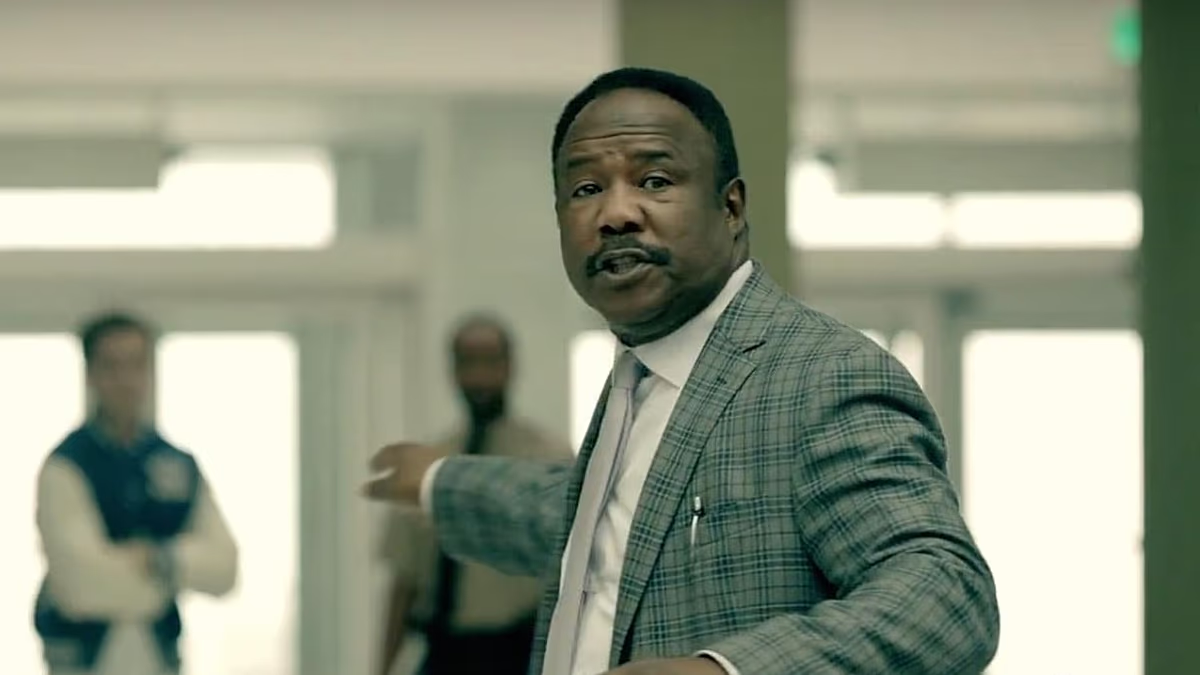
Actor Isiah Whitlock Jr., star of ‘The Wire’ and ‘Veep,’ dies at age 71 #Actor #Isiah #Whitlock #star #Wire #Veep #dies #age

ByCulture EuronewswithP.A.
Published on
Isiah Whitlock Jr., best known for his memorable roles on HBO’s The Wire and Veep, as well as his frequent collaborations with director Spike Lee, has died at the age of 71.
The news was announced Tuesday by Whitlock’s manager, Brian Liebman.
“It is with great sadness that I share the passing of my dear friend and client Isiah Whitlock Jr.,” Liebman shared on Instagram.
“If you knew him, you loved him. A brilliant actor and an even better person. May his memory forever be a blessing. Our hearts are so broken. He will be greatly missed,” he continued.
One of Whitlock’s most notable roles was as the openly corrupt State Senator Clay Davis on The Wire – widely considered one of the greatest television shows of all time.
Davis became a favorite character among fans, beloved for his profane catchphrase – “sheee-it” – uttered by Whitlock in moments of triumph and blunt honesty. The actor first used the expression in his first film with Spike Lee in 2002. The 25th hourwhen his detective character discovers a cache of drugs hidden in a sofa.
“It’s a big, big, big loss,” Lee told the AP. “I’m going to miss him for the rest of my life.”
“A beautiful and beautiful soul”
Whitlock went on to appear in four more Lee films, including the 2004 film. She hates meyears 2012 Crochet Red Summeryears 2015 Chi-Lear2018 BlackKkKlansman and the 2020s Da 5 Sangs.
“We’ve been rocking all these years,” Lee said. “We clicked from the jump. »
Lee said he has particularly fond memories of the extended time he spent with the Whitlock set. Da 5 Sangs on location in Thailand, and fondly remembers the last time he saw Whitlock at a screening of Kiss of the Spider Woman earlier this year.
“She was just a very beautiful soul,” Lee said. “If you were with him, he made everyone feel good around him. He would glow. I would put that above his acting.”
Whitlock is the second major star of The Wire to die in recent weeks following the actor’s death James Ransonwho played the petty criminal Ziggy Sobotka.
Originally from South Bend, Indiana, Whitlock grew up in a large family – one of ten siblings.
After graduating from Southwest Minnesota State University in 1976, where he played football and studied theater, injuries caused him to favor theater over sports.
He began his on-screen career with brief television guest roles on shows such as Cagney and Lacy in the late 1980s, then landed small roles in the 1990 films. The Freedmen And Gremlins 2: the new batch.
After The Wire, Whitlock moved on to another HBO show, the political satire Veep, where he played Secretary of Defense George Maddox for three seasons. The character ran against Julia Louis-Dreyfus’ Selina Meyer in the presidential primaries.
Wire creator David Simon also paid tribute to Whitlock in an article on Bluesky.
“As good an actor as he was,” said Simon, “Isiah was an even better spirit and the greatest gentleman.”
Source link
#Actor #Isiah #Whitlock #star #Wire #Veep #dies #age









News & Knowledge / Facts
Atomic clocks control our lives: that’s why there are detonations everywhere at the same time on New Year’s Eve #Atomic #clocks #control #lives #detonations #time #Years #Eve


Keystone
Without precise time, the modern world is collapsing – from GPS to the power grid. And Switzerland is one of the pioneers of this invisible order.
No time? blue News summarizes for you
- The exact time of midnight is determined by UTC universal time, which is based on measurements from many atomic clocks around the world.
- Atomic clocks are essential to our digital infrastructure because they provide highly precise time, necessary for GPS, power grids, mobile communications and the Internet, among other things.
- Switzerland plays a key role in atomic clock technology.
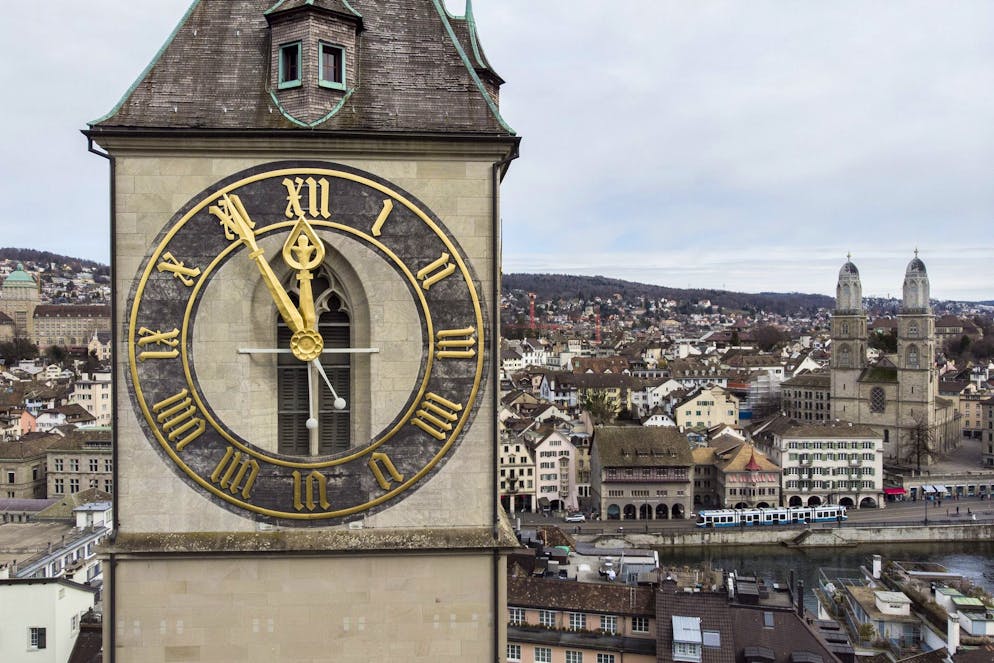
When the last seconds are counted down on New Year’s Eve, millions of people count on the clock on their cell phone, on their television or the clock in their church steeple. They all count together – five, four, three, two, one. But who really decides when exactly midnight is?
The answer leads to a world that almost no one knows about – and without which our modern daily life would immediately collapse.
Who decides when exactly midnight is?
Midnight is not about emotion. Nor is it determined by a single clock. The official world time is called UTC – Universal Time Cooperative. This time results from a global interaction of hundreds of high-precision atomic clocks, distributed in specialized laboratories around the world.
Your data circulates together at the BIPM (International Bureau of Weights and Measures) in Paris. A single bond time is calculated from all measurements. “It’s the benchmark that the whole world follows,” Steve Lecomte, member of the management team of the Swiss CSEM research center and head of the instrumentation sector, tells blue News. CSEM is active in the fields of micromanufacturing, digitalization and renewable energies, with its headquarters in Neuchâtel.
Switzerland is also part of this network: Metas, the Federal Metrology Institute in Bern, supplies temporal data to Paris. Swiss time is also directly integrated with world time.
Why is the notion of time no longer enough today?
In the past, it was enough to look at the sun. Later on a mechanical watch. Today, that is no longer enough. The reason: our world is highly connected, digital and automated. Billions of processes are running simultaneously – and they need to be perfectly synchronous.
Quartz watches, like those found in wristwatches, are practical but not perfect. “A quartz vibrates freely,” explains Lecomte. Temperature, pressure or magnetic fields can modify its frequency and thus distort time.
Keystone
Atomic clocks get around this problem. They use atoms – often cesium – as a clock. These atoms always vibrate in the same way. Everywhere. “An atom is a universal reference. A hydrogen atom behaves the same way on Earth as it does on the other side of the universe,” explains Lecomte. This makes atomic clocks extremely stable.
One second too late – what would really happen?
A second seems trivial. In the world of high technology, this is gigantic. This is particularly evident with GPS.
Satellite navigation works by receiving signals from multiple satellites. The position is calculated from the transit time of these signals. Each satellite broadcasts its exact position and current high-precision GPS time based on atomic clocks. The receiver measures the signal travel time. Multiplied by the speed of light, this gives the distance to the satellite.
But light is fast: around 300,000 kilometers per second. Lecomte calculates: “In a nanosecond (a billionth of a second, editor’s note) The light travels about 30 centimeters. In order to be able to measure our position with an accuracy of about one meter, we need to determine the time with an accuracy of at least three nanoseconds.
This means: Even a small time error results in a position error. If the time was slightly wrong, your smartphone would suddenly point you down the wrong street – or hundreds of meters away.
And GPS is just one example. Mobile networks, internet nodes and power grids also depend on the exact time.
What do electricity, the Internet and mobile communications have to do with time?
Electricity networks operate at a fixed frequency – in Europe 50 Hertz. This frequency must be synchronous everywhere. “If two waves are not synchronized, they cancel each other out,” explains Lecomte. Result: instability, breakdowns – in the worst case, damage or power outages.
Mobile networks work the same way. Thousands of antennas send and receive data. Without a common time base, data packets would collide. Videos stutter, phone calls drop, networks crash – especially during busy times like New Year’s Eve.
This is why mobile phone stations use time references from satellites and also protect themselves with local atomic clocks in the event of a satellite signal failure.
Data centers and cloud systems also need accurate time. Data is processed, compared and stored at the same time. Without precise synchronization, chaos reigns.
The key role of silent Switzerland
Although the market for atomic clocks is small, they are of extremely strategic importance. And this is precisely where Switzerland plays a central role.
A unique ecosystem has developed over the decades in Neuchâtel: universities, high-tech companies and research centers like CSEM work in close collaboration. Atomic clocks for telecommunications, satellites, navigation, military and science are created here.
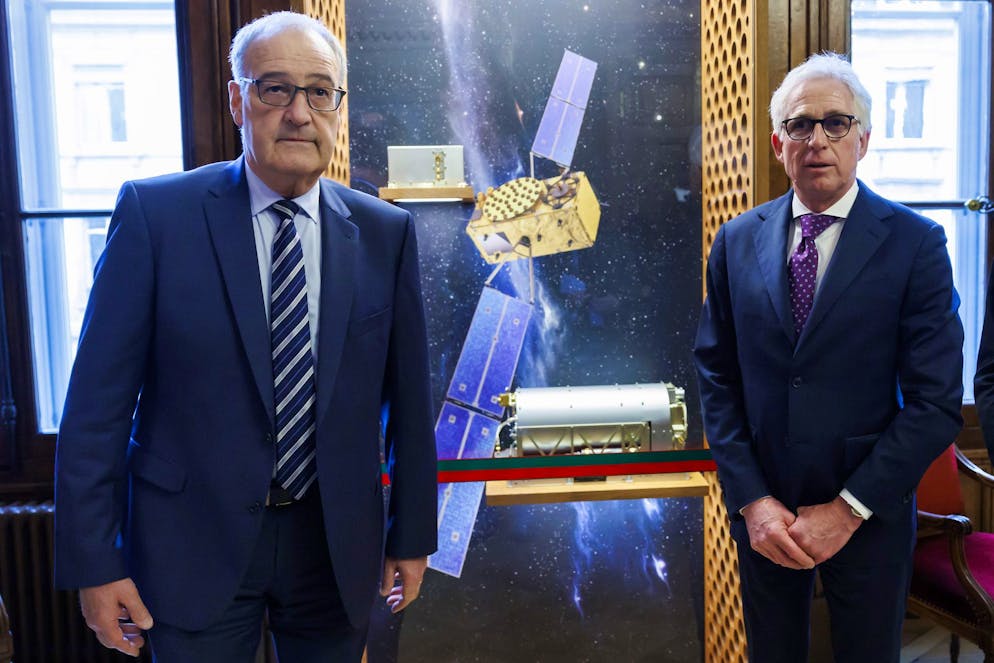
“Certain atomic clocks on the Galileo satellites come from Neuchâtel,” explains Lecomte. Galileo is the European civil global satellite navigation system allowing very precise positioning and synchronization. Swiss atomic clocks have also been involved in historic projects, for example in synchronizing telescopes that made the first image of a black hole possible.
Keystone
Switzerland’s political neutrality is an advantage. “Time is a strategic technology,” explains Lecomte. Countries want to remain independent. “China, for example, is reluctant to buy atomic clocks from the United States. » Swiss solutions, on the other hand, enjoy great confidence throughout the world.
Do we notice any of this in everyday life?
Actually no. And that’s exactly what’s amazing. As long as everything works, we don’t notice how precisely time is measured. We browse, stream, make phone calls, pay – without thinking about it.
But if there was no time, chaos would be immediate. This is not a gradual effect, but a sudden collapse of digital systems. “Without atomic clocks, our current networked world would not be possible,” says Lecomte.
Will time become even more important in the future?
“Yes,” replies Steve Lecomte. Artificial intelligence, autonomous vehicles and decentralized energy systems require perfect timing. The reason: “Machines must make decisions simultaneously, compare data in real time and maintain the stability of networks,” explains Lecomte.

Keystone
Where can I check the time on New Year’s Eve?
To toast at exactly the right time, you’ll probably need an atomic clock at home. But don’t worry: our smartphones are also extremely accurate. They continuously synchronize with official atomic clocks via the Internet (NTP server) or mobile networks (GPS signals), so deviations are only on the order of fractions of a second and are usually not noticed.
Even an atomic clock expert doesn’t think about nanoseconds at the end of the year: “Until now, I never needed an atomic clock to celebrate the New Year,” says Lecomte. And us, the laity? Like every year, we count down and make a toast. But it’s good to know that in the background, the most precise clocks in the world are ensuring that midnight is indeed midnight.
Source link
#Atomic #clocks #control #lives #detonations #time #Years #Eve
News & Knowledge / Facts
End of precious metals rally? : The money is again driven into the ground without being sharpened #precious #metals #rally #money #driven #ground #sharpened

It is precisely these developments that make the stock market so attractive. Because in 2026, everything risks happening differently than expected. While many analysts expect prices to continue to rise, a central question arises: what will be the real surprises in the coming year and how can you take advantage of them?
Our current special report highlights five developments that almost no one expects, but which have enormous return potential. From the return of oil stocks to undervalued rig stocks to the possible changing of the guard in the AI sector: if you want to perform above average in 2026, you need to think counter-cyclically and take a position early.
In the free report, we present 5 stocks that could be at the center of such turning points in 2026. Solidly valued, well positioned and with surprisingly strong momentum.
Download now for free! Before others realize where the opportunities really lie!
This exclusive PDF is only available for a limited time.
Source link
#precious #metals #rally #money #driven #ground #sharpened
News & Knowledge / Facts
New Archbishop of Canterbury ‘received hundreds of letters of support’ #Archbishop #Canterbury #received #hundreds #letters #support
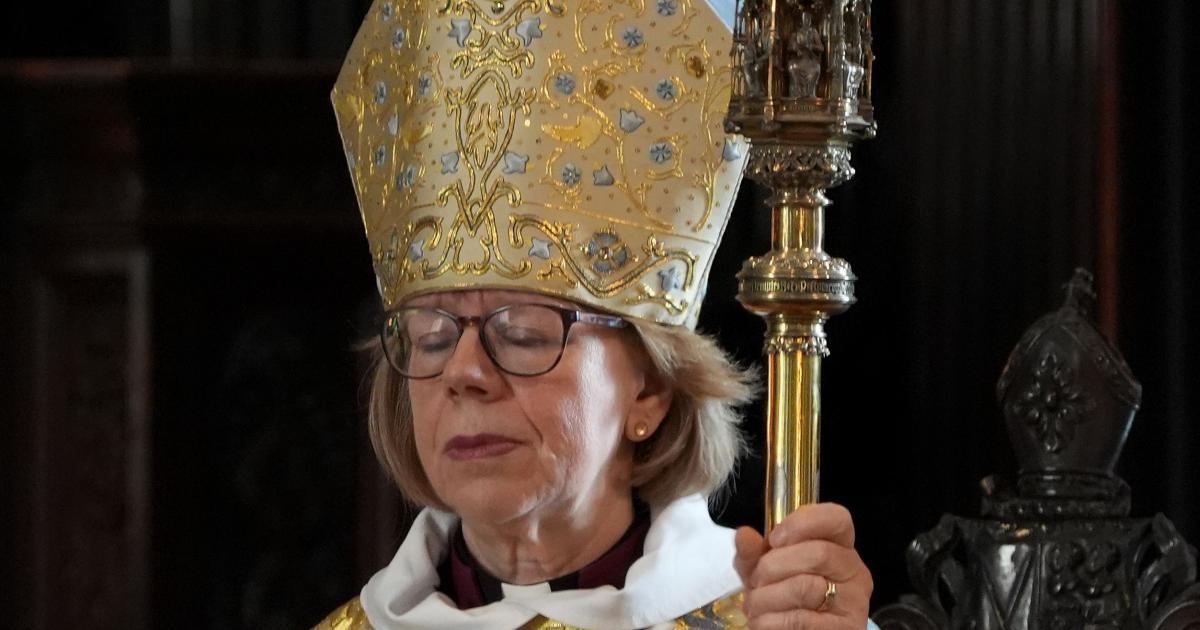
Dame Sarah Mullally will be the 106th Archbishop of Canterbury, having been chosen to succeed Justin Welby after he announced his resignation more than a year ago due to his failure to handle an abuse scandal.
Dame Sarah, who is due to take up her role on January 28, told BBC Radio 4’s Today programme: “One of the wonderful things about the last few months is that I have received hundreds and hundreds of letters of support from women.
“I got a wonderful letter from someone who said that when they went to church as children, they said to their mother, ‘I want to be like the man in the pulpit,’ and of course the mother said, ‘No, you can’t.’ She is now ordained, but she said my appointment, or the announcement of my appointment, was the first time she felt affirmed.

Dame Sarah added that “sometimes, you know, like many women, I’ve had difficult times, and I think it’s there throughout society, I think it’s changing, but I suppose to deny that would be a mistake.”
Dame Sarah was speaking to former Prime Minister Baroness Theresa May, guest editor of the Today programme, on Wednesday.
When asked how she saw the role of the Church in a world that has become much more polarized and divided, Dame Sarah replied: “Well, I think the opportunity for the Church is to provide spaces for listening and increased community cohesion.
“You know, there’s a church in every community. Interestingly enough, you see what we’re starting to see in the Christian church is this sort of quiet revival.
“I’ve been to a number of churches over the last couple of weeks where I’ve seen young people coming back to church. I think they’re looking for friendship, they’re looking for relationships. I wonder if there’s this sort of hunger for relationships outside of social media that we’re starting to see.”
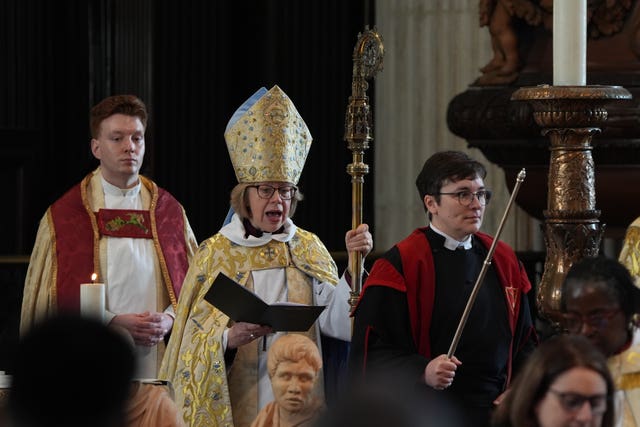
Dame Sarah said safeguarding the Anglican Church would receive her primary attention.
She said the Church of England had “significant safeguarding failures for which we are truly sorry”, and added that the Church had made progress over the past 10 years.
And she added: “We have made progress. We can never be complacent, and this will certainly be something I will give paramount attention to when I become Archbishop of Canterbury.”
Regarding assisted dying, Dame Sarah said her approach was from the perspective that she was both a nurse and a priest, and that she “sat alongside many people who had died”.
She said: “I clearly have a principled view against assisted dying.
“I think we need to care for the most vulnerable in our society. We need to have a vision that everyone is created in the image of God.
“And I suppose those who support the bill are talking about choice. I’m not sure we have a choice, particularly because we don’t fund palliative care properly. I worry that people may make the decision to seek medical assistance in dying because they don’t have the right palliative care or the right social protection.
“I also worry that there is, you know, a whole group of people who haven’t had a choice in life. These are people who, because of inequality, are more likely to get cancer and be diagnosed late and die from it.”
“What concerns me is that this group of people might be presented with options and think that because of the value judgments of others, the option is medical assistance in dying and not chemotherapy and that they have to fight for it.
“And so I worry that, in a sense, those safeguards are not in the bill, and I think I’m not sure that an amendment will make it safer.”
Source link
#Archbishop #Canterbury #received #hundreds #letters #support


Atomic clocks control our lives: that’s why there are detonations everywhere at the same time on New Year’s Eve #Atomic #clocks #control #lives #detonations #time #Years #Eve

Actor Isiah Whitlock Jr., star of ‘The Wire’ and ‘Veep,’ dies at age 71 #Actor #Isiah #Whitlock #star #Wire #Veep #dies #age
End of precious metals rally? : The money is again driven into the ground without being sharpened #precious #metals #rally #money #driven #ground #sharpened

Bus accident in Chitradurga: Complete list of passengers on board Seabird coach | News from India #Bus #accident #Chitradurga #Complete #list #passengers #board #Seabird #coach #News #India

Investigations underway after man dies in e-scooter crash in Waterford City #Investigations #underway #man #dies #escooter #crash #Waterford #City

How to Evereve Style Real Women: Favorite Influencer Looks to Try #Evereve #Style #Real #Women #Favorite #Influencer
-

 Ireland3 days ago
RIP: Christmas tragedy as two elderly men die following fire at rural Sligo house #RIP #Christmas #tragedy #elderly #men #die #fire #rural #Sligo #house
-

 News & Knowledge / Facts3 days ago
Tango is sad: singer “Chiqui” Pereyra has died #Tango #sad #singer #Chiqui #Pereyra #died
-

 News & Knowledge / Facts4 days ago
Rayan Cherki scores crucial late victory for Manchester City at Nottingham Forest #Rayan #Cherki #scores #crucial #late #victory #Manchester #City #Nottingham #Forest
-

 News & Knowledge / Facts4 days ago
Prisoner on the run in UK after fleeing on Christmas Day #Prisoner #run #fleeing #Christmas #Day
-

 News & Knowledge / Facts3 days ago
New York covered in snow, causing travel chaos #York #covered #snow #causing #travel #chaos
-
 News & Knowledge / Facts3 days ago
Brigitte Bardot is considered the “angel of animals” by the founder of Peta #Brigitte #Bardot #considered #angel #animals #founder #Peta
-

 News & Knowledge / Facts3 days ago
Zelensky to meet Trump as efforts to end Russia-Ukraine war remain elusive #Zelensky #meet #Trump #efforts #RussiaUkraine #war #remain #elusive
-

 News & Knowledge / Facts4 days ago
Indonesian rescuers search for Spanish coach and 3 children after tour boat sinks | World #Indonesian #rescuers #search #Spanish #coach #children #tour #boat #sinks #World