
United States
Tell us again how your ice agents are not terrorizing American citizens…

News & Knowledge / Facts
U.S. jobless claims fell below 200,000 last week, with layoffs at historic lows #U.S #jobless #claims #fell #week #layoffs #historic #lows

WASHINGTON – Fewer Americans filed for unemployment benefits last week, as layoffs remained low despite a weak job market.
U.S. unemployment claims for the week ending Dec. 27 fell 16,000 to 199,000 from 215,000 the previous week, the Labor Department reported Wednesday. Analysts surveyed by data firm FactSet forecast 208,000 new apps.
Claims for unemployment benefits are often skewed during shortened vacation weeks. The shorter week may cause some people who have lost their jobs to delay filing their applications.
The weekly report was released a day early due to the New Year holiday.
Applications for unemployment aid are considered a proxy for layoffs and are close to a real-time indicator of the health of the labor market.
Earlier this month, the government announced that the United States gained 64,000 jobs in November, but lost 105,000 in October, as federal workers left following the Trump administration’s budget cuts. This helped push the unemployment rate to 4.6% last month, the highest since 2021.
October’s job losses were caused by a drop of 162,000 federal employees, many of whom resigned at the end of the 2025 fiscal year on September 30 under pressure from billionaire Elon Musk’s U.S. government pay purge.
The Labor Department’s revisions also cut 33,000 jobs from the August and September payrolls.
Recent government data revealed a labor market in which hiring has clearly lost momentum, hampered by uncertainty over President Donald Trump’s tariffs and the lingering effects of high interest rates the Fed has implemented in 2022 and 2023 to curb a pandemic-induced burst of inflation. Since March, job creation has fallen to an average of 35,000 per month, compared to 71,000 for the year ended in March.
Earlier this month, the Federal Reserve cut its benchmark rate by a quarter point, its third consecutive cut.
Fed Chairman Jerome Powell said the committee reduced borrowing costs out of concern that the labor market may be even weaker than it appears. Powell said recent employment numbers could be revised down by as much as 60,000, which would mean employers have actually cut an average of about 25,000 jobs per month since the spring.
Companies that recently announced job cuts include UPS, General Motors, Amazon and Verizon.
The Labor Department’s report released Wednesday also showed that the four-week average of claims, which smooths out some of the weekly volatility, increased by 1,750 to 218,7500.
The total number of Americans filing for unemployment benefits for the previous week ending Dec. 20 fell by 47,000 to 1.87 million, the government said.
Copyright 2025 The Associated Press. All rights reserved. This material may not be published, broadcast, rewritten or redistributed without permission.
Source link
#U.S #jobless #claims #fell #week #layoffs #historic #lows
News & Knowledge / Facts
Trump’s TACO tariff parade: Here are all the times he talked a big game and didn’t back it on trade #Trumps #TACO #tariff #parade #times #talked #big #game #didnt #trade
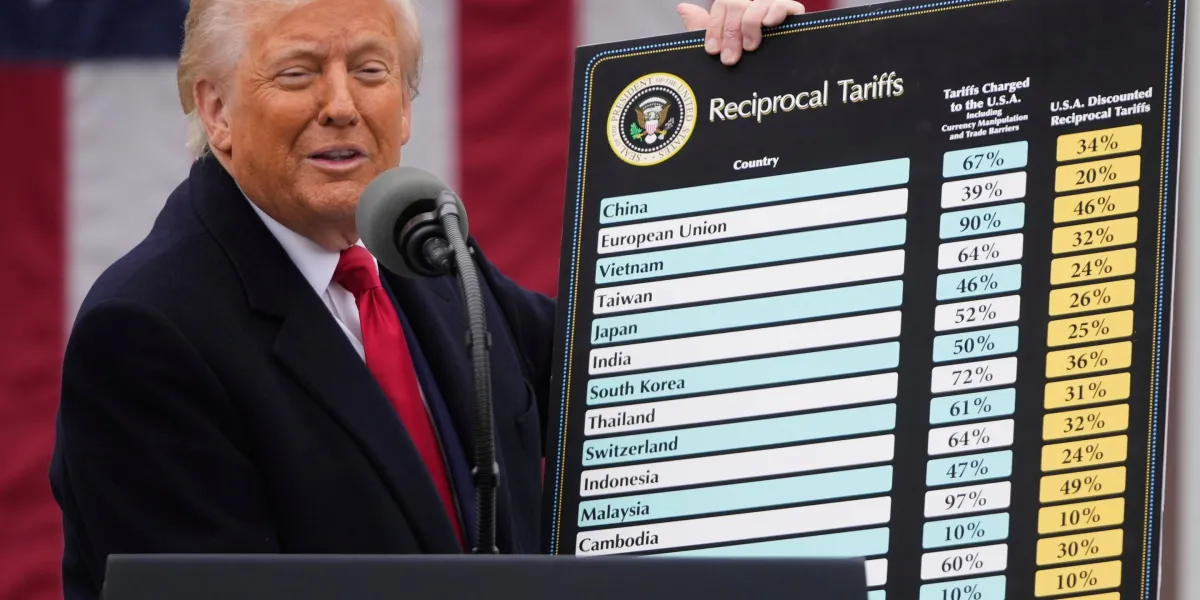
President Donald Trump has made numerous tariff threats and trade promises this year. Many of them came in the form of a series of new import taxes that upended decades of U.S. economic policy – but others have yet to be implemented as 2025 draws to a close.
Some of Trump’s unrealized threats reflect a broader approach by a president with a history of using exorbitant levies to pressure other countries into new trade deals, one-off retaliations or even to punish political critics. At the same time, they came as a growing list of tariffs took effect — from Trump’s punitive new taxes on imported metals to quid pro quo levies with major U.S. trading partners like China — plunging consumers and businesses around the world into uncertainty.
Here’s what Trump said in announcing some of his biggest (but still unfulfilled) tariff threats and promises this year, and where things stand today.
External Revenue Service
In his words:
What happened: At the end of December, the Foreign Revenue Service had not yet been created. While administration officials have continued to reiterate plans to launch the Foreign Revenue Service during the first months of Trump’s return to office, the entity does not yet exist.
200% tariff on European wines, champagnes and spirits
In his words:
What happened: The EU’s proposed levy on American whiskey — which it unveiled as part of a broader retaliation in response to Trump’s new steel and aluminum tariffs — was postponed, with the latest delay expected to run until at least February.
Trump’s threat of 200% tariffs on European alcohol never materialized. But spirits were not included in the EU-US trade deal reached over the summer, which set a 15% rate on most European imports.
100% rate on films made abroad
In his words:
What happened: Despite Trump’s repeated threats, the United States has yet to impose 100% tariffs on foreign films. After its initial promise in May to begin the process, the White House said no final decision had been made. It’s also still unclear how the United States would tax a film made abroad.
Prices on pharmaceutical drugs
In his words:
What happened: On October 1, the president did not sign an executive order imposing a 100% tariff on pharmaceuticals, and to date no levy has been implemented. But Trump previously suggested that significant levies on pharmaceutical drugs could come later, telling CNBC in August that he would start by imposing a “small tariff” and potentially raise the rate up to 250%. At the same time, trade deals with specific countries set their own rates or exemptions – the UK, for example, guaranteeing a 0% tariff on all UK medicines exported to the US for three years. The administration also announced deals with specific companies promising lower drug prices.
100% tariff on computer chips
In his words:
What happened: The total ban on computer chips has not yet taken effect. When he announced his intention to impose the levy in August, Trump did not specify the timetable. And other details remained scarce.
$2,000 rate dividend
In his words:
What happened: Details on how, when and if a tariff dividend will reach Americans are still scarce. Budget experts said the math doesn’t hold up. And Treasury Secretary Scott Bessent suggested that might not mean government checks. Instead, Bessent told ABC in November, the reduction could come in the form of tax cuts. White House National Economic Council Director Kevin Hassett also told CBS News that it’s up to Congress to decide.
Source link
#Trumps #TACO #tariff #parade #times #talked #big #game #didnt #trade
News & Knowledge / Facts
Flu cases are increasing in the United States. Here’s where it happens. #Flu #cases #increasing #United #States #Heres

A new flu variant is sweeping the United States, causing millions of reported cases and doubling the number of hospitalizations, a surge that doctors say may not stop for weeks.
Influenza activity is at “high” or “very high” levels in 32 states and jurisdictions, according to the Dec. 30 report from the Centers for Disease Control and Prevention. This is an increase from the 17 states reported the previous week. Since the start of the flu season in October, at least 7.5 million people have contracted the disease.
Hospitalizations nearly doubled in just one week, rising to 19,053 from 9,944 the week before, according to CDC data. Around 3,100 deaths have been reported. Additionally, the number of pediatric deaths increased to five, up from two the previous week.
Influenza A(H3N2) viruses are the most frequently reported influenza viruses this season.
States with the highest flu activity include Colorado, Louisiana, South Carolina, New Jersey and New York, according to the CDC.
What is the new strain of flu?
Subclade K (formerly called A(H3N2) virus subclade J.2.4.1) is a mutation of the influenza A H3N2 virus. Influenza A is usually the virus associated with the term “flu” and has evolved into many different strains over time.
Each year, the seasonal flu vaccine is formulated to target the most common strains. One of them, H3N2, has been around for decades, according to the CDC and the Gavi Vaccine Alliance, but its most recent mutation is different enough that the vaccine designed to target H3N2 for the 2025-2026 season is not as effective against it.
Because it is structurally different, the K subclade may also be more effective at dodging immune systems that have already evolved protections against more familiar strains. This year’s vaccine is not useless against the K subclade, however.
Preliminary data showed the vaccine still provides protection and rates of hospitalization and serious illness are comparable to last year in Europe, according to the Pan American Health Organization and a study published in the medical journal Eurosurveillance.
Know the symptoms of the flu
Doctors and health care professionals recommend that everyone aged 6 months and older get a flu vaccine during flu season because symptoms overlap with those of COVID-19. Your immune system can be weakened by an infection, making you more vulnerable to others.
The flu and COVID-19 have several symptoms in common. Here’s how to distinguish the two viruses:
How to protect yourself from the flu
It’s not too late to get your flu shot. The CDC, World Health Organization, and other leading medical institutions consider it to be the most effective way to prevent serious illness from the flu. Everyone aged 6 months and older is eligible for the flu vaccine unless they have a specific health problem, such as an allergy to its ingredients or a history of serious reaction to the vaccine.
Six habits to stay healthy during flu season
- Wash your hands frequently with soap and water. Scrub for 20 seconds to kill germs.
- Get your flu vaccine; it’s not too late.
- Cover your mouth and nose with a tissue, not your hands, when you sneeze or cough.
- If you feel symptoms developing, do not go to work or school. This will prevent spreading the disease to others.
- Avoid touching your eyes, nose and mouth. If you touch something that is contaminated with germs, it can easily spread disease.
- Clean and disinfect your home frequently, especially high-touch surfaces like doorknobs and counters.
Contributors: Mike Snider, Mary Walrath-Holdridge
SOURCE USA TODAY Network Reporting and Research; Centers for Disease Control and Prevention
Source link
#Flu #cases #increasing #United #States #Heres


Queen praised for speaking out about train assault as a teenager #Queen #praised #speaking #train #assault #teenager

U.S. jobless claims fell below 200,000 last week, with layoffs at historic lows #U.S #jobless #claims #fell #week #layoffs #historic #lows

Trump’s TACO tariff parade: Here are all the times he talked a big game and didn’t back it on trade #Trumps #TACO #tariff #parade #times #talked #big #game #didnt #trade

Bus accident in Chitradurga: Complete list of passengers on board Seabird coach | News from India #Bus #accident #Chitradurga #Complete #list #passengers #board #Seabird #coach #News #India

Investigations underway after man dies in e-scooter crash in Waterford City #Investigations #underway #man #dies #escooter #crash #Waterford #City

How to Evereve Style Real Women: Favorite Influencer Looks to Try #Evereve #Style #Real #Women #Favorite #Influencer
-

 Ireland3 days ago
RIP: Christmas tragedy as two elderly men die following fire at rural Sligo house #RIP #Christmas #tragedy #elderly #men #die #fire #rural #Sligo #house
-

 News & Knowledge / Facts3 days ago
Tango is sad: singer “Chiqui” Pereyra has died #Tango #sad #singer #Chiqui #Pereyra #died
-

 News & Knowledge / Facts4 days ago
Rayan Cherki scores crucial late victory for Manchester City at Nottingham Forest #Rayan #Cherki #scores #crucial #late #victory #Manchester #City #Nottingham #Forest
-

 News & Knowledge / Facts4 days ago
Prisoner on the run in UK after fleeing on Christmas Day #Prisoner #run #fleeing #Christmas #Day
-

 News & Knowledge / Facts3 days ago
Brigitte Bardot is considered the “angel of animals” by the founder of Peta #Brigitte #Bardot #considered #angel #animals #founder #Peta
-

 News & Knowledge / Facts3 days ago
New York covered in snow, causing travel chaos #York #covered #snow #causing #travel #chaos
-

 Ireland3 days ago
Cutting-edge research into ‘mini-brains’ at the University of Galway #Cuttingedge #research #minibrains #University #Galway
-

 News & Knowledge / Facts3 days ago
Zelensky to meet Trump as efforts to end Russia-Ukraine war remain elusive #Zelensky #meet #Trump #efforts #RussiaUkraine #war #remain #elusive