
News & Knowledge / Facts
Atomic clocks control our lives: that’s why there are detonations everywhere at the same time on New Year’s Eve #Atomic #clocks #control #lives #detonations #time #Years #Eve



Keystone
Without precise time, the modern world is collapsing – from GPS to the power grid. And Switzerland is one of the pioneers of this invisible order.
No time? blue News summarizes for you
- The exact time of midnight is determined by UTC universal time, which is based on measurements from many atomic clocks around the world.
- Atomic clocks are essential to our digital infrastructure because they provide highly precise time, necessary for GPS, power grids, mobile communications and the Internet, among other things.
- Switzerland plays a key role in atomic clock technology.
When the last seconds are counted down on New Year’s Eve, millions of people count on the clock on their cell phone, on their television or the clock in their church steeple. They all count together – five, four, three, two, one. But who really decides when exactly midnight is?
The answer leads to a world that almost no one knows about – and without which our modern daily life would immediately collapse.
Who decides when exactly midnight is?
Midnight is not about emotion. Nor is it determined by a single clock. The official world time is called UTC – Universal Time Cooperative. This time results from a global interaction of hundreds of high-precision atomic clocks, distributed in specialized laboratories around the world.
Your data circulates together at the BIPM (International Bureau of Weights and Measures) in Paris. A single bond time is calculated from all measurements. “It’s the benchmark that the whole world follows,” Steve Lecomte, member of the management team of the Swiss CSEM research center and head of the instrumentation sector, tells blue News. CSEM is active in the fields of micromanufacturing, digitalization and renewable energies, with its headquarters in Neuchâtel.
Switzerland is also part of this network: Metas, the Federal Metrology Institute in Bern, supplies temporal data to Paris. Swiss time is also directly integrated with world time.
Why is the notion of time no longer enough today?
In the past, it was enough to look at the sun. Later on a mechanical watch. Today, that is no longer enough. The reason: our world is highly connected, digital and automated. Billions of processes are running simultaneously – and they need to be perfectly synchronous.
Quartz watches, like those found in wristwatches, are practical but not perfect. “A quartz vibrates freely,” explains Lecomte. Temperature, pressure or magnetic fields can modify its frequency and thus distort time.

Keystone
Atomic clocks get around this problem. They use atoms – often cesium – as a clock. These atoms always vibrate in the same way. Everywhere. “An atom is a universal reference. A hydrogen atom behaves the same way on Earth as it does on the other side of the universe,” explains Lecomte. This makes atomic clocks extremely stable.
One second too late – what would really happen?
A second seems trivial. In the world of high technology, this is gigantic. This is particularly evident with GPS.
Satellite navigation works by receiving signals from multiple satellites. The position is calculated from the transit time of these signals. Each satellite broadcasts its exact position and current high-precision GPS time based on atomic clocks. The receiver measures the signal travel time. Multiplied by the speed of light, this gives the distance to the satellite.
But light is fast: around 300,000 kilometers per second. Lecomte calculates: “In a nanosecond (a billionth of a second, editor’s note) The light travels about 30 centimeters. In order to be able to measure our position with an accuracy of about one meter, we need to determine the time with an accuracy of at least three nanoseconds.
This means: Even a small time error results in a position error. If the time was slightly wrong, your smartphone would suddenly point you down the wrong street – or hundreds of meters away.
And GPS is just one example. Mobile networks, internet nodes and power grids also depend on the exact time.
What do electricity, the Internet and mobile communications have to do with time?
Electricity networks operate at a fixed frequency – in Europe 50 Hertz. This frequency must be synchronous everywhere. “If two waves are not synchronized, they cancel each other out,” explains Lecomte. Result: instability, breakdowns – in the worst case, damage or power outages.
Mobile networks work the same way. Thousands of antennas send and receive data. Without a common time base, data packets would collide. Videos stutter, phone calls drop, networks crash – especially during busy times like New Year’s Eve.
This is why mobile phone stations use time references from satellites and also protect themselves with local atomic clocks in the event of a satellite signal failure.
Data centers and cloud systems also need accurate time. Data is processed, compared and stored at the same time. Without precise synchronization, chaos reigns.
The key role of silent Switzerland
Although the market for atomic clocks is small, they are of extremely strategic importance. And this is precisely where Switzerland plays a central role.
A unique ecosystem has developed over the decades in Neuchâtel: universities, high-tech companies and research centers like CSEM work in close collaboration. Atomic clocks for telecommunications, satellites, navigation, military and science are created here.
“Certain atomic clocks on the Galileo satellites come from Neuchâtel,” explains Lecomte. Galileo is the European civil global satellite navigation system allowing very precise positioning and synchronization. Swiss atomic clocks have also been involved in historic projects, for example in synchronizing telescopes that made the first image of a black hole possible.

Keystone
Switzerland’s political neutrality is an advantage. “Time is a strategic technology,” explains Lecomte. Countries want to remain independent. “China, for example, is reluctant to buy atomic clocks from the United States. » Swiss solutions, on the other hand, enjoy great confidence throughout the world.
Do we notice any of this in everyday life?
Actually no. And that’s exactly what’s amazing. As long as everything works, we don’t notice how precisely time is measured. We browse, stream, make phone calls, pay – without thinking about it.
But if there was no time, chaos would be immediate. This is not a gradual effect, but a sudden collapse of digital systems. “Without atomic clocks, our current networked world would not be possible,” says Lecomte.
Will time become even more important in the future?
“Yes,” replies Steve Lecomte. Artificial intelligence, autonomous vehicles and decentralized energy systems require perfect timing. The reason: “Machines must make decisions simultaneously, compare data in real time and maintain the stability of networks,” explains Lecomte.

Keystone
Where can I check the time on New Year’s Eve?
To toast at exactly the right time, you’ll probably need an atomic clock at home. But don’t worry: our smartphones are also extremely accurate. They continuously synchronize with official atomic clocks via the Internet (NTP server) or mobile networks (GPS signals), so deviations are only on the order of fractions of a second and are usually not noticed.
Even an atomic clock expert doesn’t think about nanoseconds at the end of the year: “Until now, I never needed an atomic clock to celebrate the New Year,” says Lecomte. And us, the laity? Like every year, we count down and make a toast. But it’s good to know that in the background, the most precise clocks in the world are ensuring that midnight is indeed midnight.
Source link
#Atomic #clocks #control #lives #detonations #time #Years #Eve











Ireland
Grassmarket businesses warn of possible power outages in Hogmanay #Grassmarket #businesses #warn #power #outages #Hogmanay

Some businesses experienced power outages in Edinburgh’s Old Town on Tuesday, which SP Energy Networks said was due to an “intermittent outage”, followed by a further “power outage” in the morning at Hogmanay.
Around 30 restaurants and bars in the area have been “crippled” by a significant loss of Christmas trade due to persistent grid energy outages, according to a spokesperson for Grassmarket Hospitality Operators.
It warns that power outages risk reputational damage and “indicate systemic vulnerabilities that require an urgent and permanent solution.”
Paul Lawrence, chief executive of the City of Edinburgh Council, and Culture Secretary Angus Robertson were briefed and copied in an email from the operators group.
Louise MacLean, business development director at Signature Group, which has sites across Scotland, said: “Businesses in Grassmarket have reported repeated power losses, but the long-standing problem remains unresolved.

Grassmarket businesses said the issue is affecting their reputation (Alamy/PA)
“Some hospitality venues also experienced power outages several times a day over the festive period, plunging the Christmas trade into the dark.
“Over the course of just one weekend in December, Grassmarket businesses lost their entire Friday evening service and their entire Saturday lunchtime service, meaning thousands of pounds in lost revenue across several hospitality venues.
“Meanwhile, business costs remain. Staff still need to be paid for power back-up, food waste and lost bookings.”
In a letter to SP Energy Networks chief executive Nicola Connelly, the hotel collective warned of its “deep concern regarding repeated power outages occurring over the Christmas periods from 2021 to 2025”.
It said: “These disruptions have had a significant impact on our operations, customer experience, visitor experience and the overall reputation of the business and the city.
“We have been informed that SPEN may have to cut supplies again tomorrow (Hogmanay).
“This compromises our business and Edinburgh’s reputation as the ultimate Hogmanay destination… These repeated failures have resulted in substantial financial loss, property damage and reputational damage during peak periods.
“It also has an impact on Edinburgh’s reputation.”
The energy company has committed to making staff available during Hogmanay in the event of further outages.
A spokesperson said: “We are experiencing intermittent issues with the power supply in the Grassmarket area of Edinburgh and would like to reassure all customers and businesses that we are doing all we can to resolve the issue as quickly as possible ahead of the Hogmanay celebrations which begin later.
“Yesterday’s outages were the result of a low voltage protection fuse operating due to an intermittent fault, which caused customers to be shut down for an hour in the afternoon, between approximately 3pm and 5pm, and again from 6pm to 8pm.
“We are fully aware of the impact this will have caused at such a busy time of year, and we apologize for any inconvenience caused.”
“The power went out again mid-morning today and we are currently on site working to resolve this issue as quickly as possible.
“Our staff have been going door to door at the Grassmarket to reassure customers that we are doing everything we can to ensure there is no further disruption today.
“We will also have additional staff on standby tonight between the bells and into the early hours.
“We look forward to meeting with all relevant groups in the new year to discuss our investment plans to strengthen the network and mitigate any disruption in the future.”
Source link
#Grassmarket #businesses #warn #power #outages #Hogmanay
News & Knowledge / Facts
Queen praised for speaking out about train assault as a teenager #Queen #praised #speaking #train #assault #teenager
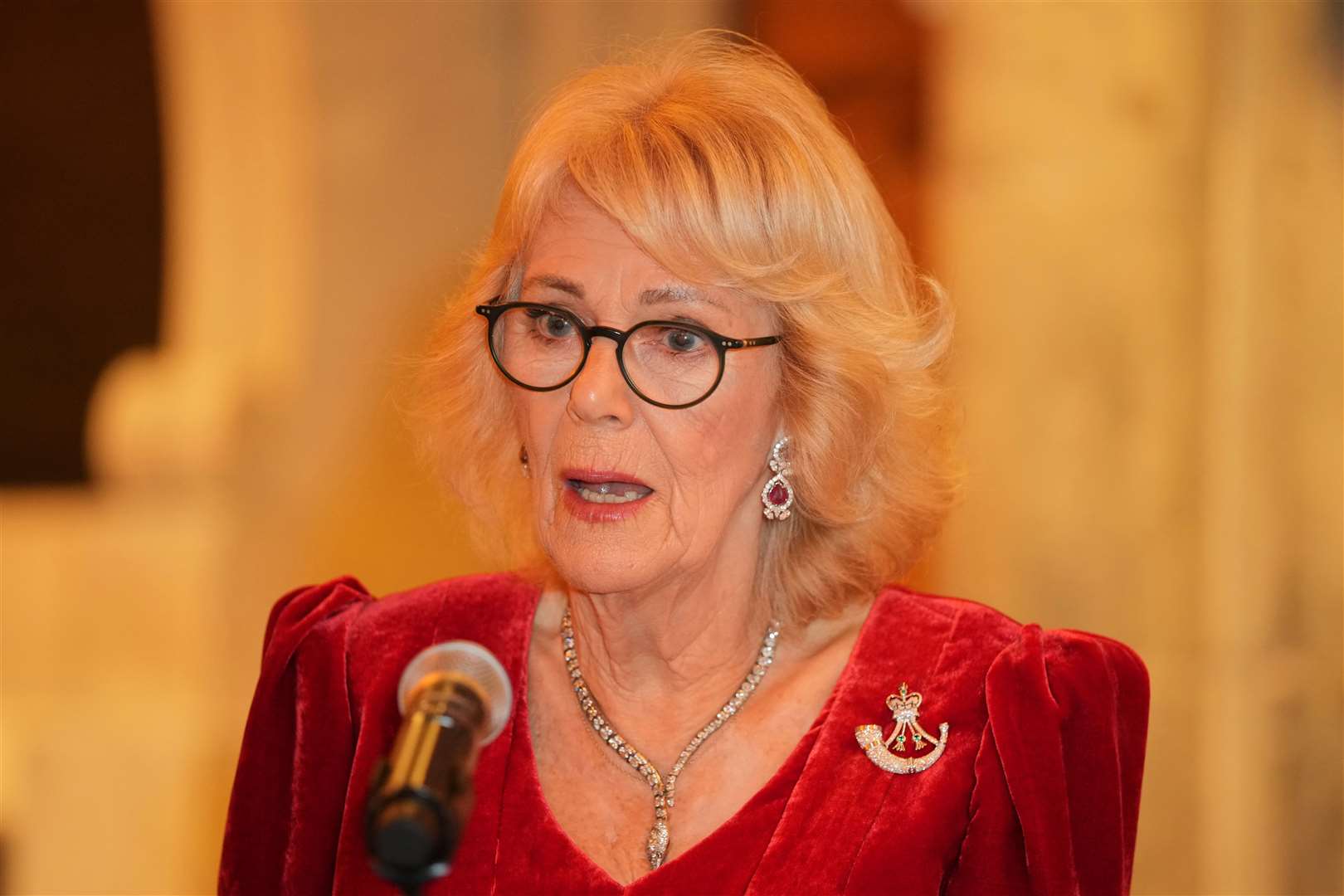
The Queen was praised by the UK’s special envoy for women and girls for speaking out about her attack on a train when she was a teenager.
Camilla recalled on a radio show being “so angry” and “furious” when she was attacked, while in conversation with John Hunt and his daughter Amy, whose family were murdered at their home last year, and former prime minister Baroness Theresa May.
Speaking to Sarah Montague on BBC Radio 4’s World at One, Baroness Harman described the Queen speaking about her experience of assault as “so important”.
Louise Hunt, 25, her sister Hannah Hunt, 28, and their mother Carol Hunt, 61, were killed by Kyle Clifford, 27 – Louise’s ex-partner – in a quiet cul-de-sac in Bushey, Hertfordshire, on July 9 last year.


Camilla said in the recording, broadcast on BBC Radio 4’s Today programme: “I remember something that had been hiding in the back of my brain for a very long time, that when I was a teenager I was attacked on a train, and I had sort of forgotten about it, but I remember at the time I was so angry. It was anger.”
She added: “Someone I didn’t know. I was reading my book, and you know, this boy, dude, attacked me, and I fought back.
“And I remember getting off the train and my mother looked at me and said, ‘Why does your hair stand up?’ and “Why is there a button missing on your coat?” “.
“But I remember the anger, and I was so furious about it, and it was sort of hidden for many years.
“And I think, you know, when the whole subject of domestic violence comes up and all of a sudden you hear a story like John and Amy’s, it’s something that’s very close to my heart.”
After hearing the Queen tell the story, Amy Hunt said: “Thank you first of all for sharing this story, Your Majesty, because it takes a lot of time to share these things, because every woman has a story.”

Speaking on BBC Radio 4’s World at One, Baroness Harman said: “In the past, when a woman was killed by her husband or partner, the consensus was that she must have caused it herself and the women’s movement opposed this argument.
“We’re now seeing a new form of this argument emerging among people like Andrew Tate and on social media, a new kind of toxic masculinity that basically says that men are struggling with their identities and that the fault lies with women, because women’s progress has undermined men’s sense of self and that sometimes pushes them to resort to violence.”
She spoke of her own experiences saying: “It happened to me at work, it happened to me at university, it happened to me as a young girl traveling to London and as a young girl going to the cinema, for so long there has been a feeling that nothing can be done, no action will be taken, I will be blamed, I will be told that I caused it myself.” »
Asked if there was a difference in generational attitude, with younger women and girls being more able to express themselves than older generations, she said: “I think the attitudes of women and girls have changed enormously, but the important thing is to move from those strong attitudes to actual reality and although I think the argument has been won to a large extent, the reality has remained the same. »
On the feasibility of the government’s plan to halve violence against women and girls, she said: “There’s nothing inevitable that says it’s just one of those things and nothing can be done about it… I think it’s up to all of us not to stand back and criticize, but to play our part.”
The incident involving the Queen was first recounted in the book Power And The Palace: The Inside Story Of The Monarchy And 10 Downing Street by Valentine Low, a former royal reporter for The Times newspaper.
Camilla did “what my mother taught me” and took off her shoe to fend off the man while on her way to London’s Paddington Station in the early 1960s, aged 16 or 17, it was previously reported.
In Power And The Palace, Boris Johnson’s former communications director Guto Harri recalls Mr Johnson telling him about meeting the Queen at her official London residence, Clarence House, around 2008, the year the politician was first elected Mayor of London.
In the extract, published in the Sunday Times earlier this year, Mr Harri said of the couple: “They obviously got on like a house on fire. He (Mr Johnson) was making guttural noises about how much he admired and loved her.”
Mr Harri then spoke about a conversation between Camilla and Mr Johnson, about an assault she said happened when she was a schoolgirl.
“She was on a train going to Paddington – she was about 16, 17 – and a guy was moving his hand further and further away…”
Mr Harri said that after Mr Johnson asked her what she did next, Camilla replied: “I did what my mother taught me. I took off my shoe and kicked his nuts with my heel.
“She was confident enough when they got to Paddington to jump off the train, find a guy in uniform and say, ‘This man has just attacked me,’ and he was arrested.”
The Queen has visited sexual assault centers in the UK and abroad, held receptions for survivors of sexual assault and domestic violence and spoken out on the issue, but her experience as a teenager has not been the main driver of her work, but rather the stories of women who have suffered assault.
Source link
#Queen #praised #speaking #train #assault #teenager
News & Knowledge / Facts
U.S. jobless claims fell below 200,000 last week, with layoffs at historic lows #U.S #jobless #claims #fell #week #layoffs #historic #lows

WASHINGTON – Fewer Americans filed for unemployment benefits last week, as layoffs remained low despite a weak job market.
U.S. unemployment claims for the week ending Dec. 27 fell 16,000 to 199,000 from 215,000 the previous week, the Labor Department reported Wednesday. Analysts surveyed by data firm FactSet forecast 208,000 new apps.
Claims for unemployment benefits are often skewed during shortened vacation weeks. The shorter week may cause some people who have lost their jobs to delay filing their applications.
The weekly report was released a day early due to the New Year holiday.
Applications for unemployment aid are considered a proxy for layoffs and are close to a real-time indicator of the health of the labor market.
Earlier this month, the government announced that the United States gained 64,000 jobs in November, but lost 105,000 in October, as federal workers left following the Trump administration’s budget cuts. This helped push the unemployment rate to 4.6% last month, the highest since 2021.
October’s job losses were caused by a drop of 162,000 federal employees, many of whom resigned at the end of the 2025 fiscal year on September 30 under pressure from billionaire Elon Musk’s U.S. government pay purge.
The Labor Department’s revisions also cut 33,000 jobs from the August and September payrolls.
Recent government data revealed a labor market in which hiring has clearly lost momentum, hampered by uncertainty over President Donald Trump’s tariffs and the lingering effects of high interest rates the Fed has implemented in 2022 and 2023 to curb a pandemic-induced burst of inflation. Since March, job creation has fallen to an average of 35,000 per month, compared to 71,000 for the year ended in March.
Earlier this month, the Federal Reserve cut its benchmark rate by a quarter point, its third consecutive cut.
Fed Chairman Jerome Powell said the committee reduced borrowing costs out of concern that the labor market may be even weaker than it appears. Powell said recent employment numbers could be revised down by as much as 60,000, which would mean employers have actually cut an average of about 25,000 jobs per month since the spring.
Companies that recently announced job cuts include UPS, General Motors, Amazon and Verizon.
The Labor Department’s report released Wednesday also showed that the four-week average of claims, which smooths out some of the weekly volatility, increased by 1,750 to 218,7500.
The total number of Americans filing for unemployment benefits for the previous week ending Dec. 20 fell by 47,000 to 1.87 million, the government said.
Copyright 2025 The Associated Press. All rights reserved. This material may not be published, broadcast, rewritten or redistributed without permission.
Source link
#U.S #jobless #claims #fell #week #layoffs #historic #lows


Grassmarket businesses warn of possible power outages in Hogmanay #Grassmarket #businesses #warn #power #outages #Hogmanay

Softbank provides $40 billion in backing to OpenAI, sources tell CNBC #Softbank #billion #backing #OpenAI #sources #CNBC

Queen praised for speaking out about train assault as a teenager #Queen #praised #speaking #train #assault #teenager

Bus accident in Chitradurga: Complete list of passengers on board Seabird coach | News from India #Bus #accident #Chitradurga #Complete #list #passengers #board #Seabird #coach #News #India

Investigations underway after man dies in e-scooter crash in Waterford City #Investigations #underway #man #dies #escooter #crash #Waterford #City

How to Evereve Style Real Women: Favorite Influencer Looks to Try #Evereve #Style #Real #Women #Favorite #Influencer
-

 Ireland3 days ago
RIP: Christmas tragedy as two elderly men die following fire at rural Sligo house #RIP #Christmas #tragedy #elderly #men #die #fire #rural #Sligo #house
-

 News & Knowledge / Facts3 days ago
Tango is sad: singer “Chiqui” Pereyra has died #Tango #sad #singer #Chiqui #Pereyra #died
-

 News & Knowledge / Facts4 days ago
Prisoner on the run in UK after fleeing on Christmas Day #Prisoner #run #fleeing #Christmas #Day
-

 News & Knowledge / Facts3 days ago
New York covered in snow, causing travel chaos #York #covered #snow #causing #travel #chaos
-

 News & Knowledge / Facts3 days ago
Brigitte Bardot is considered the “angel of animals” by the founder of Peta #Brigitte #Bardot #considered #angel #animals #founder #Peta
-
 Ireland3 days ago
Cutting-edge research into ‘mini-brains’ at the University of Galway #Cuttingedge #research #minibrains #University #Galway
-

 News & Knowledge / Facts3 days ago
Zelensky to meet Trump as efforts to end Russia-Ukraine war remain elusive #Zelensky #meet #Trump #efforts #RussiaUkraine #war #remain #elusive
-

 News & Knowledge / Facts4 days ago
Indonesian rescuers search for Spanish coach and 3 children after tour boat sinks | World #Indonesian #rescuers #search #Spanish #coach #children #tour #boat #sinks #World