
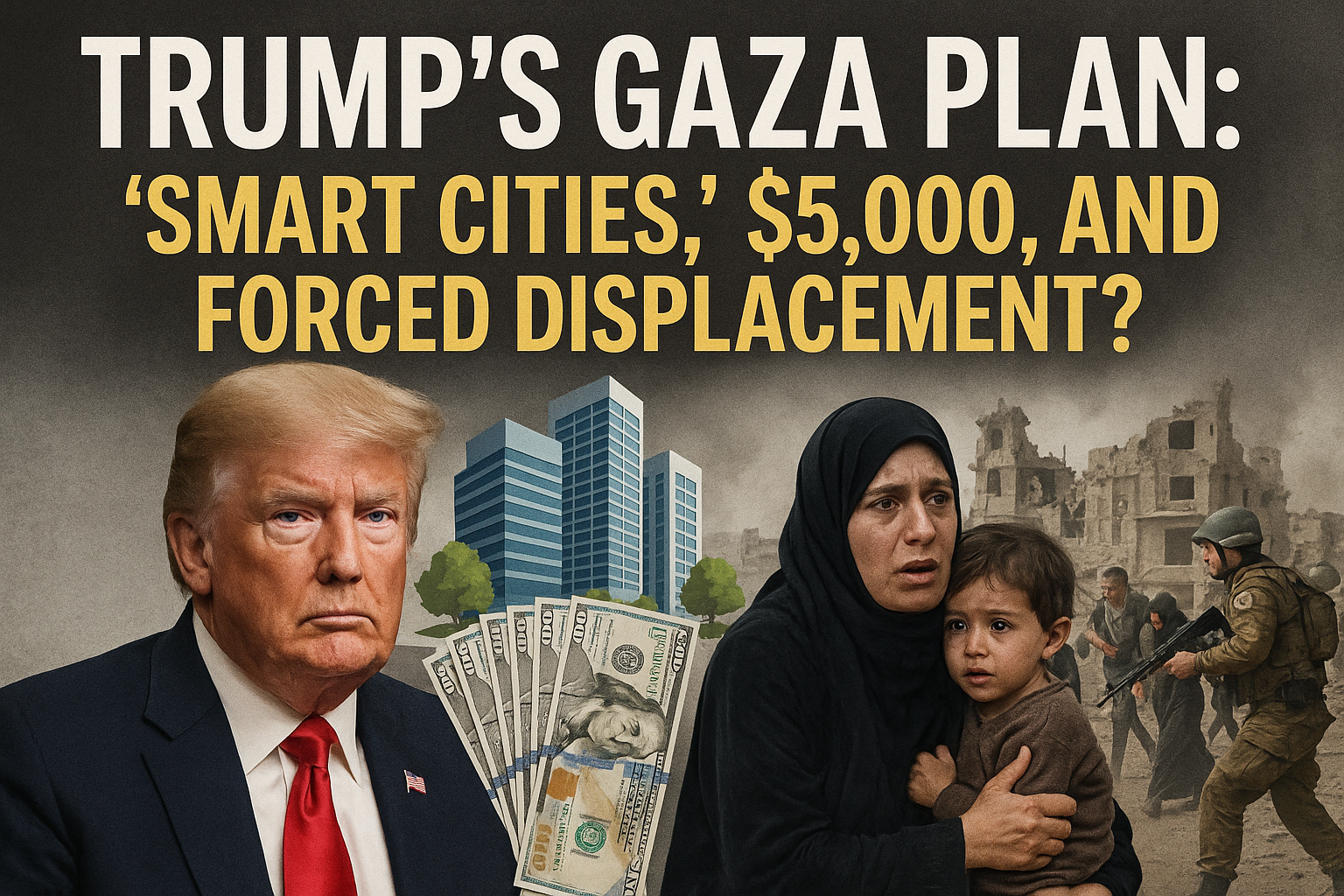
Trump’s Gaza Plan: ‘Smart Cities,’ $5,000, and Forced Displacement?
A Blueprint for Dispossession and Profit
In an era increasingly defined by complex global challenges, a proposed plan for Gaza emerges not as a beacon of hope, but as a chilling blueprint for displacement, control, and outright dehumanization. This isn’t merely a development project; it is a profound betrayal of human dignity, disguised as progress, and it demands our unwavering condemnation.
United States President Donald Trump’s administration is reportedly examining this far-reaching plan, which outlines a decade-long US trusteeship over Gaza. The very premise—placing a sovereign territory under external control for such an extended period—immediately raises alarms about autonomy and self-determination.
The core of this audacious project, as detailed in a 38-page draft proposal obtained by The Washington Post, is known as the Gaza Reconstitution, Economic Acceleration and Transformation Trust (GREAT Trust). It aims to transform Gaza into a “hub for tourism, advanced industries and urban mega-projects”. This vision, reminiscent of Trump’s earlier remarks about turning Gaza into “the Riviera of the Middle East,” completely disregards the existing population, their history, and their undeniable rights to their homeland. It reduces a vibrant, if war-torn, society to a blank canvas for foreign architectural fantasies, a clear manifestation of a “Rigged Game” where the rules are stacked for the powerful and against the powerless.
——————————————————————————–
Forced Exodus: Cash for Land, Tokens for Displacement
The most striking, and arguably most egregious, element of this proposal is its explicit call for the relocation of Gaza’s roughly two million residents. Under the GREAT Trust, these individuals would be forced to either “temporarily leave the territory or move into restricted areas while reconstruction was underway”.
To facilitate this mass displacement, a system of “financial incentives” is dangled before a population already facing immense hardship.
• $5,000 Cash and Subsidies: Each individual accepting this arrangement would reportedly receive $5,000 in cash, along with rent subsidies covering four years and food supplies for twelve months.
• Digital Land Tokens: Property owners, in turn, would be compelled to relinquish their land in exchange for “digital tokens”. These tokens, described as tradable instruments, could later be redeemed for apartments in the newly developed smart cities or, shockingly, “liquidated to support relocation abroad”.
Let us be unequivocal: this is not an offer of aid; it is a thinly veiled scheme for coerced exodus. Human rights organizations have rightly cautioned that any plan involving mass relocation, no matter how it is framed, “could amount to a violation of international law”. Offering cash for departure, especially to a population under siege and facing “famine conditions,” exploits dire vulnerability. It preys on the desperate circumstances of people who have already suffered immeasurably, treating their ancestral lands and inherent rights as mere commodities to be exchanged for digital currency or a meager sum.
This mechanism, designed to create “a mechanism to fund redevelopment projects while providing displaced residents with temporary financial stability,” stands as a stark example of “modern servitude,” where ordinary lives are reduced to disposable data points in a system that benefits distant corporations and “mega-projects”. The proposal asserts that investments would come from private and public funds, explicitly stating “no direct American government expenditure would be required”, highlighting the stark profit motive over genuine humanitarian concern.
——————————————————————————–
A Vision of Luxury, Built on Dispossession
The architectural vision outlined in the GREAT Trust document further solidifies its inhumane nature. Gaza is to be divided into “six to eight distinct ‘AI-powered smart cities'”. The blueprints imagine “high-rise apartment towers,” “parks, commercial districts, and coastal resorts,” alongside “highways, mass transit, and industrial complexes”.
Notably, two major highways are even proposed to carry the names of prominent Gulf leaders, the “MBS Highway” (referencing Saudi Crown Prince Mohammed bin Salman) and one after UAE President Mohammed bin Zayed al-Nahyan. Additional projects include electric vehicle plants, data centers, and high-capacity infrastructure designed to connect Gaza with regional markets.
This grand design, with its “skyscrapers, artificial intelligence-driven smart cities, luxury resorts, golf courses, and high-tech facilities,” stands in jarring contrast to the reality of Gaza, which the source itself describes as “one of the most densely populated and war-damaged territories in the world”. It is a vision utterly detached from the lives, cultural heritage, and aspirations of the Palestinian people, reducing them to obstacles in the path of opulent, foreign-funded development. This focus on abstract infrastructure while actively displacing the populace underscores a profound “Moral Fade” from public life, where decency and human rights are overshadowed by cynicism and self-interest.
——————————————————————————–
The Troubling Role of the Gaza Humanitarian Foundation (GHF)
Adding another layer of controversy is the involvement of the Gaza Humanitarian Foundation (GHF). This “controversial US-backed group” is explicitly “closely tied to the plan” and currently “handles the delivery of food aid into Gaza”.
Operating with “logistical support from private American security companies and coordination with the Israeli military,” the GHF has been promoted by the Trump administration and Israel as an “alternative to UN-run humanitarian channels”. However, its record is grim. The United Nations reported that “more than 1,000 Palestinians had been killed near GHF aid distribution points since May this year, the majority shot by Israeli forces guarding the sites”.
This devastating toll fuels criticism that the GHF’s model not only “bypasses established humanitarian systems but also exposes civilians to heightened risks”. The administration’s view of GHF as the “preferred vehicle for administering assistance during any reconstruction program” is deeply troubling. It exemplifies how “guardians” supposedly meant to protect are instead “lost or compromised,” swayed by influence and hidden agendas, leaving citizens “exposed and unprotected”. The very act of distributing aid, a fundamental humanitarian duty, is twisted into a mechanism fraught with danger, further diminishing the “strength” of an already suffering population.
——————————————————————————–
Security and Control: A Decade of External Oversight
The proposed security arrangements are equally disturbing. During the first year of trusteeship, “Israel would retain broad authority to act on its security needs”. Internal policing, meanwhile, would be carried out by “international personnel, including contractors from private Western military firms”.
The long-term plan envisions a transfer of control to a “reconstituted Palestinian administration,” but only after it “must demonstrate both reform and ‘de-radicalisation'”. This is not a pathway to self-governance; it is a mandate for prolonged occupation and social engineering. The imposition of external policing and the demand for “de-radicalisation” are profoundly insulting and inherently colonial, stripping Palestinians of their right to self-determination and imposing a foreign definition of acceptable governance. It is a clear instance of the “Rigged Game” where the powerful dictate not just the rules of economy, but the very political and social fabric of a people. The “unsettling question” arises: “who are they watching, and for whose benefit?” When institutions meant to protect citizens are perceived as monitoring or controlling them, “the feeling of betrayal is profound”.
——————————————————————————–
Controversial Authorship and Alternative Visions
Further discrediting this proposal is the controversy surrounding its authorship. The Washington Post reported that two former partners of the Boston Consulting Group (BCG)—Michael Eisenberg, an Israeli-American, and Liran Tancman, a former Israeli military intelligence officer—were involved in drafting the proposal. BCG has since “disavowed the work they undertook,” stating they are “shocked and outraged” and will not be paid for it. The fact that such a significant plan lacks legitimate, authorized backing from the very entities it purports to involve speaks volumes about its dubious origins and ethical standing.
Moreover, this proposal stands in stark contrast to initiatives advanced by Arab states. Saudi Arabia and the UAE have jointly pledged $53 billion for an “Egypt plan” that “envisages rebuilding Gaza in just five years with towers, ports, parks, and business hubs — without requiring population removal”. This comparison alone exposes the uniquely inhumane and problematic nature of the Trump administration’s vision for Gaza. Former British Prime Minister Tony Blair has also been advising Trump’s Middle East envoy Steve Witkoff on proposals, with polling suggesting Gazans prefer a future akin to the prosperity of the United Arab Emirates.
——————————————————————————–
Gaza’s Present Reality: Bombardment and Famine
All of these plans circulate while Gaza continues to endure “heavy bombardment”. The current reality is one of “disrupted aid distribution” and “worsened conditions for civilians,” with “around 514,000 people—about one quarter of Gaza’s population—facing famine conditions,” primarily in Gaza City and nearby districts. Israeli authorities have dismissed these findings as biased, illustrating a profound disregard for human suffering.
To discuss “reconstruction blueprints” amidst such immediate and devastating humanitarian crises demonstrates a grotesque disconnect from reality. The “Loss of Strength” imposed on the Palestinian people by ongoing conflict, coupled with the systemic pressures of such proposals, creates a situation where the act of simply “choosing to breathe” becomes an act of defiance in itself. The ongoing discussion of potential annexation of parts of the West Bank by Israel further underscores a broader agenda that continually disempowers and dispossesses Palestinians, rather than offering genuine peace and self-determination.
——————————————————————————–
Conclusion: Rejecting the “Rigged Game” of Dispossession
In conclusion, the GREAT Trust proposal for Gaza is not a path to peace or prosperity; it is a strategic maneuver designed to facilitate a forcible transfer of population, exploit a humanitarian crisis for profit, and impose external control under the guise of redevelopment. It embodies the very essence of an inhumane proposal, reducing a people to disposable variables in a geopolitical equation.
As an editor, I cannot stand idly by as such a plan gains traction. We must recognize it for what it is: a continuation of a “Rigged Game” where the most vulnerable are forced to contend with “Guardians Lost” and a pervasive “Moral Fade”. True solutions for Gaza must begin with unconditional respect for human rights, self-determination, and genuine humanitarian relief, not with a plan that seeks to rebuild over the graves and homes of its existing inhabitants. We must reject proposals that reduce human lives to “data points” or “assets” and demand a future for Gaza built on justice, dignity, and peace, where its people are not displaced, but empowered to rebuild their own lives, in their own land.